
2 step equations pdf
Two-step equations require utilizing inverse operations in a specific sequence to isolate the variable, offering a foundational skill in algebra.
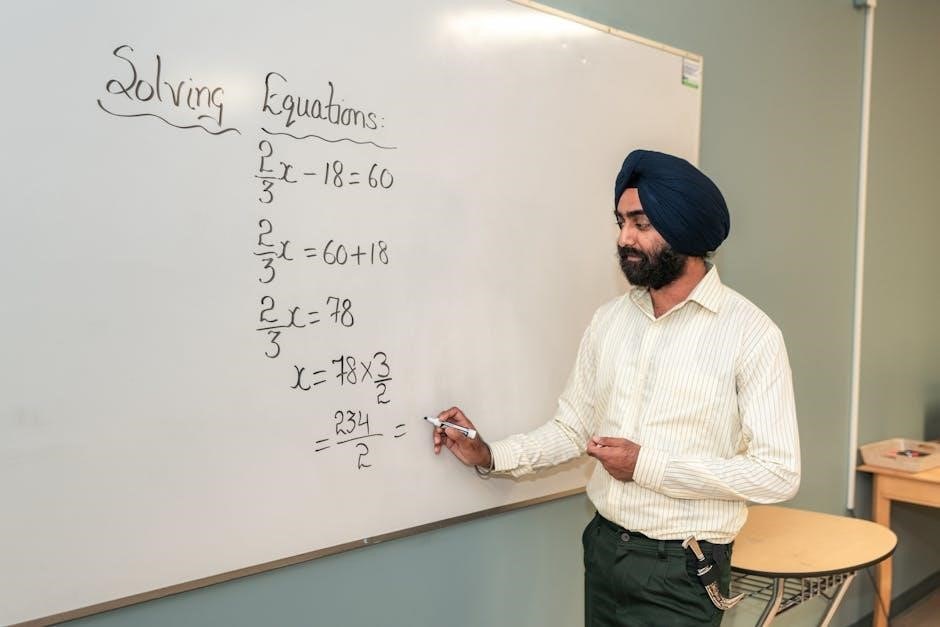
Numerous resources, including PDF worksheets from Kuta Software, provide practice problems and step-by-step solutions for mastering these equations.
What are Two-Step Equations?
Two-step equations are algebraic equations that necessitate performing two operations to isolate the variable and determine its value. Unlike one-step equations, solving these requires a sequence of inverse operations – typically addition or subtraction followed by multiplication or division.
These equations build upon the foundation of understanding how to maintain balance within an equation, ensuring that any operation applied to one side is mirrored on the other. Many online resources and PDF worksheets, like those offered by Kuta Software, present a variety of these problems.
These resources often include detailed, step-by-step solutions, allowing learners to grasp the process effectively. Mastering two-step equations is crucial for progressing to more complex algebraic concepts.
Why are They Important?
Two-step equations serve as a vital stepping stone in algebra, bridging the gap between simple arithmetic and more complex equation solving. They reinforce the core principle of maintaining equation balance through inverse operations, a skill essential for future mathematical endeavors.
Proficiency in solving these equations builds a strong foundation for tackling multi-step equations, inequalities, and ultimately, more advanced algebraic concepts. Numerous PDF worksheets and online solvers provide ample practice opportunities.
Resources like Kuta Software offer structured practice, enabling students to build confidence and fluency. Understanding two-step equations isn’t just about finding ‘x’; it’s about developing logical thinking and problem-solving abilities.

Understanding the Core Concepts
Mastering two-step equations hinges on grasping inverse operations and the goal of isolating the variable, often practiced through readily available PDF worksheets.
Inverse Operations
Inverse operations are crucial for solving two-step equations, effectively “undoing” the mathematical processes applied to the variable. Addition and subtraction are inverses, as are multiplication and division. Understanding this concept is fundamental; for instance, to isolate a variable multiplied by a number, you’d employ division.
These operations maintain the equation’s balance, ensuring the solution remains valid. Many PDF resources, like those from Kuta Software, emphasize practicing with inverse operations. Worksheets often present equations requiring both addition/subtraction and multiplication/division to isolate the variable. Successfully applying these inverses is the key to unlocking the value of the unknown variable and verifying the solution.
Consistent practice with PDF worksheets reinforces this core skill.
The Goal: Isolating the Variable
The primary objective when solving two-step equations is to isolate the variable – to get it alone on one side of the equation. This means performing operations to move all other terms to the opposite side, ultimately revealing the variable’s value. This is achieved through the strategic application of inverse operations, maintaining balance throughout the process.
PDF worksheets, readily available online (including resources from Kuta Software), provide ample practice in this skill. They present various equations requiring students to systematically apply inverse operations. The goal isn’t simply to find an answer, but to understand how the variable becomes isolated, building a strong foundation for more complex algebraic concepts. Mastering this skill is essential for future mathematical success.

Solving Two-Step Equations: A Step-by-Step Guide
PDF resources detail a clear process: first, address addition or subtraction, then tackle multiplication or division to isolate the variable.
Step 1: Addition or Subtraction
PDF worksheets consistently emphasize beginning with addition or subtraction to unravel two-step equations. This initial move focuses on eliminating any constants added to or subtracted from the term containing the variable. For instance, if an equation presents “+3” alongside the variable term, you’d subtract 3 from both sides to maintain balance.
Conversely, if the equation shows “-5”, addition becomes the tool to neutralize it. Remember, the core principle is to isolate the variable term. Many PDF guides illustrate this with simple examples, reinforcing the concept of inverse operations. This first step simplifies the equation, preparing it for the subsequent multiplication or division stage. Mastering this foundational step is crucial for success.
Step 2: Multiplication or Division
Following the initial addition or subtraction, PDF resources dedicated to two-step equations highlight the second crucial step: multiplication or division. This stage addresses any coefficient multiplying the variable. If the variable is being multiplied by a number (like 2x), division is employed to isolate it. Conversely, if the variable is being divided by a number (like x/4), multiplication becomes the appropriate operation.
Again, consistency is key – perform the operation on both sides of the equation. Numerous PDF practice problems demonstrate this, emphasizing the importance of inverse operations. This final step yields the solution for the variable. Careful attention to signs (positive or negative) is vital throughout this process, as demonstrated in many examples within these guides.

Examples of Two-Step Equations with Solutions
PDF worksheets offer diverse examples, like solving 2x + 3 = 7 or (x/4) ౼ 1 = 2, with detailed, step-by-step solutions for clarity.
Example 1: Solving 2x + 3 = 7
Let’s demonstrate solving 2x + 3 = 7, a classic two-step equation often found in PDF practice materials. First, we aim to isolate the term with ‘x’. To do this, we subtract 3 from both sides of the equation, maintaining balance: 2x + 3 ౼ 3 = 7 ౼ 3, which simplifies to 2x = 4.
Now, to solve for ‘x’, we need to undo the multiplication. We achieve this by dividing both sides of the equation by 2: (2x) / 2 = 4 / 2. This results in x = 2. Therefore, the solution to the equation 2x + 3 = 7 is x = 2. Many PDF resources, like those from Kuta Software, will walk you through similar problems, reinforcing this process.
Always remember to check your answer by substituting it back into the original equation to verify its correctness.
Example 2: Solving (x/4) ౼ 1 = 2
Let’s tackle (x/4) ― 1 = 2, another common two-step equation frequently presented in PDF worksheets. Our initial goal is to isolate the term containing ‘x’. We begin by adding 1 to both sides of the equation: (x/4) ― 1 + 1 = 2 + 1, simplifying to (x/4) = 3.
Next, we need to eliminate the division by 4. To do this, we multiply both sides of the equation by 4: ((x/4) * 4) = 3 * 4. This results in x = 12. Therefore, the solution to the equation (x/4) ౼ 1 = 2 is x = 12.
Numerous PDF practice problems, available online and through resources like Kuta Software, offer similar exercises to solidify your understanding of this process. Remember to verify your solution!
Example 3: Solving -3x + 5 = -10
Now, let’s solve -3x + 5 = -10, a two-step equation often found in practice PDFs. First, we isolate the term with ‘x’ by subtracting 5 from both sides: -3x + 5 ౼ 5 = -10 ― 5, which simplifies to -3x = -15.
Next, we eliminate the coefficient -3 by dividing both sides of the equation by -3: (-3x) / -3 = -15 / -3. This results in x = 5. Therefore, the solution to the equation -3x + 5 = -10 is x = 5.
Many PDF worksheets, including those from Kuta Software, provide similar problems to reinforce this skill. Always double-check your answer by substituting it back into the original equation!

Common Mistakes to Avoid
When solving two-step equations (often practiced via PDFs), remember to apply inverse operations correctly and maintain the equation’s balance consistently.
Forgetting Inverse Operations
A frequent error when tackling two-step equations – readily available for practice in PDF format from resources like Kuta Software – is overlooking the necessity of employing inverse operations. Students sometimes attempt to directly manipulate the equation without reversing the operations performed on the variable.
For instance, if an equation involves multiplication and addition, failing to undo the addition before addressing the multiplication leads to an incorrect solution. Remember, inverse operations “undo” each other: addition and subtraction, multiplication and division.
Carefully identify the operations acting on the variable and apply their inverses in the correct order. Utilizing practice PDFs and diligently showing your work can help solidify this crucial concept and prevent this common mistake.
Incorrect Order of Operations
When solving two-step equations – often practiced using PDF worksheets – a common pitfall is applying operations in the wrong sequence. Students may mistakenly attempt to isolate the variable by performing multiplication or division before handling addition or subtraction.
Recall the fundamental principle: address addition or subtraction first to begin isolating the term with the variable. Only then should you proceed with multiplication or division to finally solve for the variable’s value.
Numerous PDF resources emphasize this order. Consistently practicing with these materials and consciously following the order of operations will minimize errors and build confidence in solving these essential algebraic problems. Always double-check your steps!
Practice Problems & Resources
Abundant two-step equation practice is available, including downloadable PDF worksheets from Kuta Software and various online solvers for immediate feedback.
Worksheets for Two-Step Equations
PDF worksheets are an invaluable resource for mastering two-step equations, offering focused practice and skill development. Kuta Software provides comprehensive worksheets, often including answer keys for self-assessment and immediate feedback. These worksheets typically present a variety of problems, ranging in difficulty, allowing students to build confidence gradually.
Many worksheets are designed to reinforce the core concepts of inverse operations and the correct order of operations. They often include problems with positive and negative numbers, encouraging a deeper understanding of algebraic principles. Searching online for “two-step equations worksheet PDF” yields numerous free and paid options, catering to diverse learning needs and preferences. Utilizing these resources consistently will significantly improve problem-solving abilities.
Online Two-Step Equation Solvers
While worksheets (often available as PDFs) provide practice, online two-step equation solvers offer a different learning approach. These tools allow students to input equations and receive instant solutions, demonstrating the process step-by-step. This can be incredibly helpful for checking answers and understanding where mistakes might occur.
However, it’s crucial to use these solvers as a learning aid, not a replacement for independent problem-solving. Relying solely on solvers can hinder the development of essential algebraic skills. Many websites offer these solvers alongside practice problems and tutorials, creating a comprehensive learning environment. Remember to verify the solver’s accuracy and focus on understanding how the solution is reached, not just the answer itself.
Kuta Software Resources
Kuta Software LLC is a widely recognized provider of mathematics worksheets, and their resources for two-step equations are particularly valuable. They offer numerous PDF worksheets specifically designed to build proficiency in solving these types of equations. These worksheets typically include a variety of problems, ranging in difficulty, allowing students to progressively challenge themselves.
Many Kuta Software worksheets also come with answer keys, enabling self-assessment and immediate feedback. This is crucial for reinforcing learning and identifying areas needing further practice. Beyond basic practice, Kuta Software often provides worksheets that incorporate real-world applications, helping students understand the practical relevance of two-step equations. Their structured approach makes learning efficient and effective.

Advanced Two-Step Equations
PDF resources extend to equations with negative numbers and fractions, demanding careful application of inverse operations and a solid understanding of arithmetic.
Equations with Negative Numbers
Solving two-step equations involving negative numbers requires meticulous attention to detail and a firm grasp of integer operations. Many PDF worksheets, like those offered by Kuta Software, specifically target these scenarios, providing ample practice opportunities.
When encountering negative coefficients or constants, remember that applying inverse operations must maintain the equation’s balance. For instance, adding a negative number is equivalent to subtraction, and dividing by a negative number changes the sign of both sides.
Carefully track the signs throughout each step to avoid common errors. Utilizing resources with detailed solutions, often found in PDF format, can be incredibly beneficial for understanding the correct approach and identifying potential pitfalls. Practice consistently to build confidence and proficiency.
Equations with Fractions
Two-step equations featuring fractions introduce an additional layer of complexity, demanding proficiency in fraction arithmetic. Fortunately, numerous PDF resources, including worksheets from Kuta Software and online solvers, offer targeted practice and step-by-step guidance.
When a variable is divided by a fraction, remember to multiply both sides of the equation by the reciprocal of that fraction to isolate the variable. Conversely, if a fraction is added or subtracted, ensure a common denominator is established before performing the operation.
Detailed solutions, often available in PDF format, can illuminate the correct order of operations and help avoid common mistakes. Consistent practice with these types of equations builds confidence and solidifies understanding.

Real-World Applications of Two-Step Equations
Two-step equations model numerous real-world scenarios, and PDF practice problems help students apply these skills to practical problem-solving contexts.
Problem Solving with Two-Step Equations
Successfully tackling word problems hinges on translating real-world scenarios into mathematical equations. Two-step equations frequently arise when modeling situations involving an initial value, a change, and a desired outcome. For instance, determining the number of items one can purchase with a limited budget often requires setting up and solving such an equation.
Many PDF resources, like worksheets from Kuta Software, present these problems in a structured format, guiding students through the process of defining variables, formulating the equation, and applying inverse operations to arrive at the solution. These resources often include detailed step-by-step explanations, enhancing comprehension and building confidence in problem-solving abilities. Mastering this skill is crucial for applying mathematical concepts to everyday life.
Using Equations to Model Scenarios
Two-step equations excel at representing practical situations where a quantity undergoes two distinct mathematical operations. Consider scenarios involving a starting amount altered by both addition/subtraction and multiplication/division – these are ideal candidates for modeling with these equations. For example, calculating the cost of a rental with an initial fee plus a per-day charge.
Numerous PDF worksheets, readily available online (including those from Kuta Software), provide diverse scenarios specifically designed for practice. These resources demonstrate how to translate word problems into algebraic expressions and then solve them using inverse operations. By consistently applying this process, students develop a strong ability to abstract real-world complexities into manageable mathematical models, fostering analytical thinking.
Tips for Success
Consistent practice with two-step equations, utilizing PDF worksheets, is key. Always show your work and meticulously check answers for accuracy!
Showing Your Work
Demonstrating each step when solving two-step equations isn’t merely about fulfilling a teacher’s requirement; it’s a crucial learning strategy. Clearly outlining each inverse operation – addition, subtraction, multiplication, or division – minimizes errors and fosters a deeper understanding of the underlying principles.
When utilizing PDF worksheets or online solvers, resist the temptation to skip steps. Write down the original equation, then meticulously record each transformation. This detailed approach allows for easy identification of mistakes. If you arrive at an incorrect answer, reviewing your written steps will pinpoint where the error occurred.
Furthermore, showing your work provides a valuable record for future study and review, especially when tackling more complex algebraic concepts. It’s a habit that builds confidence and solidifies your problem-solving skills.
Checking Your Answers
After solving a two-step equation, verifying your solution is paramount to ensuring accuracy. This simple yet effective technique involves substituting your obtained value back into the original equation. If both sides of the equation balance – meaning they result in the same numerical value – your solution is correct.
Whether you’re working through problems on a PDF worksheet from Kuta Software or utilizing an online solver, always dedicate a moment to this crucial step. It’s a safeguard against arithmetic errors or misapplication of inverse operations.
Consistent answer-checking reinforces a habit of precision and builds confidence in your algebraic abilities. It transforms potential mistakes into learning opportunities, solidifying your grasp of the concepts.
Mastering two-step equations builds a strong algebraic foundation, readily reinforced by practice using resources like PDF worksheets for continued success.
Recap of Key Concepts
Successfully navigating two-step equations hinges on a firm grasp of inverse operations – addition/subtraction and multiplication/division – applied in the correct order. The primary goal is always to isolate the variable, meticulously balancing both sides of the equation with each operation performed.
Remember, these equations demand two distinct steps to unravel the solution. Numerous PDF resources, such as those offered by Kuta Software, provide ample practice. These worksheets present a variety of problems, reinforcing the application of these core principles. Consistent practice with these PDF materials solidifies understanding and builds confidence in solving these fundamental algebraic challenges. Always check your answers to ensure accuracy!
Further Learning Resources
To deepen your understanding of two-step equations, explore the wealth of online resources available. Many websites offer interactive tutorials and practice exercises, complementing traditional PDF worksheets. Kuta Software provides extensive PDF materials, including worksheets with detailed solutions, ideal for self-paced learning and reinforcing concepts.
Beyond worksheets, consider utilizing online two-step equation solvers to verify your answers and identify areas for improvement. These tools can be invaluable for building confidence and solidifying your problem-solving skills. Remember to focus on understanding the process, not just obtaining the answer. Consistent practice with diverse PDF resources and online tools will ensure mastery.